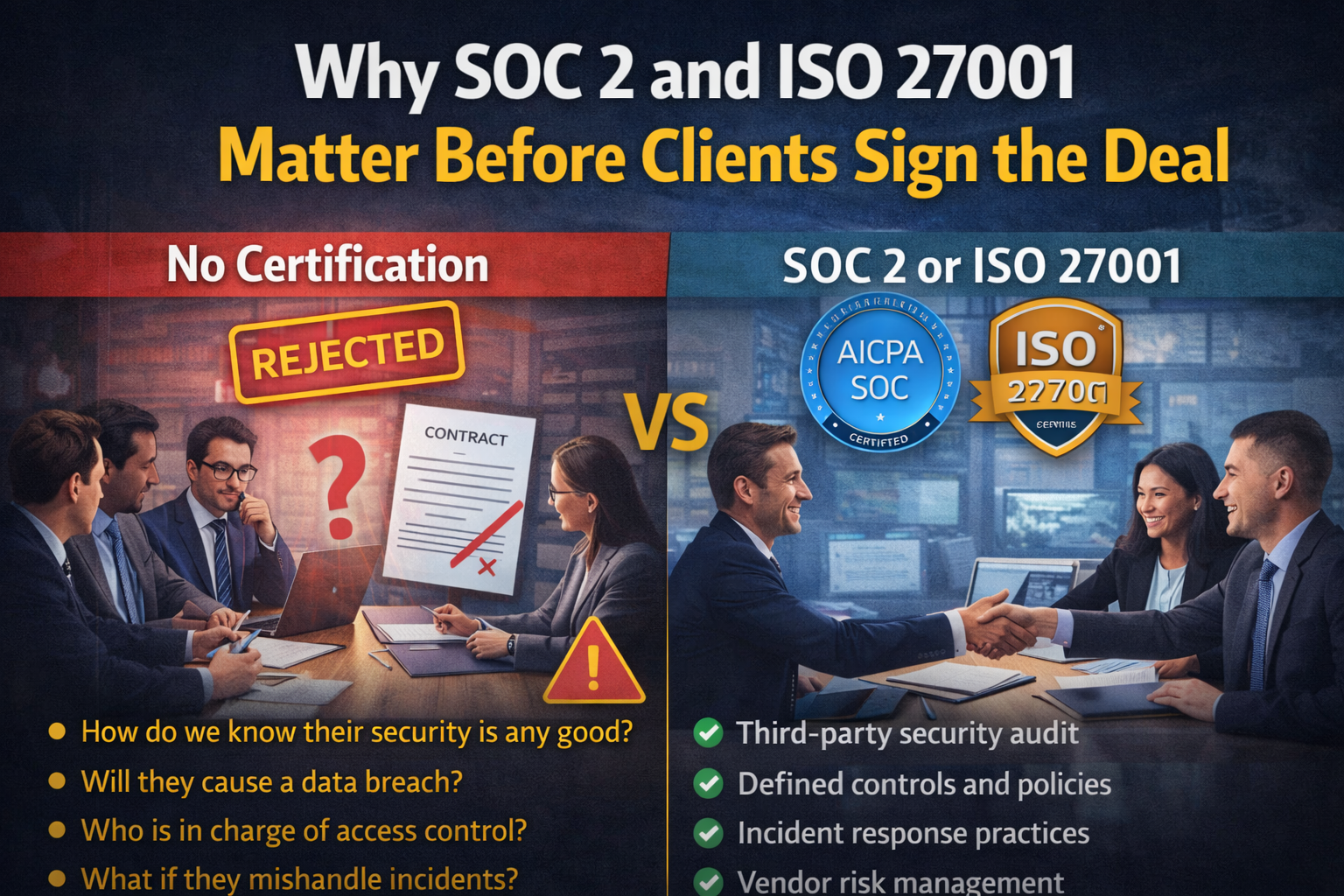
Why SOC 2 and ISO 27001 Matter Before Clients Sign the Deal
A lot of companies think SOC 2 and ISO 27001 are just paperwork for enterprise sales.
That is usually how it feels when the first security questionnaire lands in your inbox.
But from the client side, the reason is simple: they are trying to reduce risk before they trust another company with customer data, internal workflows, or critical infrastructure.
If your product touches sensitive data, integrates into other systems, or becomes part of a client's daily operations, security is no longer a nice extra. It becomes part of the buying decision.
SOC 2 and ISO 27001 are not the same thing, but they often answer the same client question: can we trust this company to handle security in a consistent way?
Why clients ask about compliance early
I usually see this come up before the technical team even starts onboarding.
The sales process gets close to a deal, then legal, procurement, or security steps in and asks for proof that the vendor is not going to become the weakest link.
That is where the demand for SOC 2 and ISO 27001 becomes real.
Clients are not only buying features. They are buying reduced operational risk.
Without some recognized security framework in place, a vendor review starts to feel uncertain:
- Do they have access control in place?
- Do they review who can reach production systems?
- Do they manage incidents properly?
- Do they handle vendor risk?
- Do they have a repeatable security process, or are they improvising?
A company may have good engineers and still fail here if nothing is documented, monitored, reviewed, and enforced consistently.
What SOC 2 gives you
SOC 2 is usually the one SaaS companies hear about first.
The value is not that it magically makes a company secure. The value is that it forces the company to prove that security controls actually exist and are being followed.
That matters to clients because promises are cheap. Evidence is harder to fake.
In practice, SOC 2 helps show that a company has controls around things like:
- access management
- logging and monitoring
- change management
- incident response
- risk management
- vendor oversight
The important part is not the PDF report itself. The important part is that the report gives the client a third-party assessment of how those controls are designed and, in a Type II audit, how they operate over time.
This reduces friction in the buying process because the client does not have to start every review from zero.
A strong SOC 2 report shortens security reviews because it answers a lot of common vendor-risk questions before the client has to ask them one by one.
What ISO 27001 gives you
ISO 27001 solves a similar trust problem, but from a different angle.
Instead of focusing mainly on attesting to specific control environments for customer assurance, ISO 27001 is built around an information security management system.
That sounds formal, but the idea is simple: security should be managed as a system, not as a pile of disconnected tools and policies.
This is what makes ISO 27001 attractive to clients, especially international ones.
It tells them the company has a structured way to:
- identify risks
- assess those risks
- choose controls
- document policies
- train people
- review effectiveness
- improve over time
The mistake many companies make is treating security as a set of one-time fixes. ISO 27001 pushes the company toward a repeatable process instead.
For clients, that is valuable because stable process is easier to trust than ad hoc effort.
Why these certifications are in such high demand
The short answer is that clients do not want surprises after the contract is signed.
A vendor can expose the client to real business damage:
- data breaches
- downtime
- legal exposure
- regulatory issues
- brand damage
- supply-chain risk
So clients increasingly use compliance as a filtering mechanism.
If two vendors offer similar features and similar pricing, the one with recognized security assurance usually feels safer to buy from.
This is especially true when selling into:
- enterprise customers
- fintech
- healthcare
- government-adjacent work
- platforms handling personal or customer business data
In those environments, security review is not optional. It is part of procurement.
That is why SOC 2 and ISO 27001 are often demand signals from the market, not just trends from security teams.
They help clients answer these questions faster:
| Client concern | What they want to know | Why compliance helps |
|---|---|---|
| Security maturity | Is this company operating responsibly? | Shows defined controls and formal process |
| Vendor risk | Will this vendor become our weak point? | Provides third-party assurance |
| Procurement delay | Will security review block the deal? | Speeds up due diligence |
| Ongoing trust | Can they maintain security over time? | Demonstrates repeatable governance |
| Incident readiness | Will they respond well when something goes wrong? | Indicates policies, ownership, and review structure |
Why this matters before business starts
Once the deal is signed, the client inherits part of your risk.
That is the part many founders underestimate.
If your product stores files, processes customer records, sends emails, accesses internal APIs, or plugs into a client environment, they are effectively extending trust to your team and your systems.
From their perspective, asking for SOC 2 or ISO 27001 before the relationship starts is just basic due diligence.
It helps them avoid questions like these later:
- Why did we onboard a vendor without a formal security program?
- Why was access control handled informally?
- Why was there no audit trail for key changes?
- Why did we trust a provider that could not show security ownership?
This is not just about passing audits. It is about reducing uncertainty before risk becomes shared.
No certification guarantees perfect security. A company can still have bad implementations, weak engineering decisions, or poor incident handling. But lacking any recognized framework often makes trust much harder to establish.
The real business benefit for vendors
From the vendor side, the biggest benefit is not the badge.
It is the leverage.
SOC 2 and ISO 27001 can help a company:
- close deals faster
- qualify for larger clients
- reduce back-and-forth during security reviews
- build trust with procurement teams
- show maturity beyond marketing claims
- create internal security discipline
This is where compliance stops being a cost center and starts becoming part of sales enablement.
A lot of smaller companies only pursue it after losing deals. That pattern is common.
The client says the product looks good, the pricing works, the team likes the demo, but procurement blocks the deal because the vendor cannot answer security questions with enough confidence.
That is usually the moment compliance stops feeling theoretical.
What clients are really buying
They are not buying a certificate.
They are buying confidence that your company will behave predictably when handling security-sensitive work.
That confidence comes from things like:
- documented access reviews
- incident response ownership
- change tracking
- asset inventory
- risk assessment
- employee security awareness
- policy enforcement
- regular review
SOC 2 and ISO 27001 help package that confidence into something a client can assess without having to reverse-engineer your entire company.
That is why these frameworks keep showing up before contracts, not after.
Final thought
The demand for SOC 2 and ISO 27001 is not driven by hype.
It is driven by trust, procurement pressure, and the cost of getting vendor security wrong.
If you are selling to serious clients, especially in B2B SaaS, compliance is often not about looking impressive. It is about removing doubt.
And in a sales cycle, reducing doubt is often what gets the deal over the line.